Unknown's avatar

About bobwyss

Bob Wyss is a Journalism Professor Emeritus at the University of Connecticut and a freelance writer. He has written three books and thousands of newspaper and magazine stories during his career..

Leaders Hear Radical Ideas

The story so far: On November 28, 1939, 75 years ago, a thick, black smoke covered St. Louis, turning day into night, snarling traffic and angering and shocking residents. The three city newspaper’s began a campaign to eliminate the smoke, but the coal dealers and producers who had created the problem had always fought and won previous efforts to end the pollution.

By Bob Wyss

A week had passed since the worst of the black smoke had descended. It had not relented. True, the smoke lifted for a while, but it always came back. It may not have been as thick as a week ago, but it was unavoidable.

The decision to fight the smoke was also unavoidable. Mayor Bernard Dickmann had invited 52 citizens to City Hall today in the wake of the smoke crisis. They came from business, the universities, civic organizations and from government. They were virtually all men, except for Jeanne Blythe of the St. Louis League of Women Voters. It was an extraordinary gathering that was destined to feature some radical ideas.
DSCN0630

Fifty-two leaders come to City Hall

It was also a staged event. Dickmann made it clear very early that he had a resolution that he wanted passed that involved appointing a small committee to investigate the smoke problem. He told the crowd he was looking for strong measures, although it was not a time for “hysteria. This is not a program you can settle within 30 days. But we can solve it over a three or four-year program if we keep our feet on the ground and handle it constructively, where it will do the least harm.”

Three proposals were presented to the gathering.

Joseph M. Darst, the city’s director of public welfare, proposed what he called an educational campaign. In actuality, it involved stationing city employees (hired under the federal WPA or Works Progress Administration) on each block where the pollution was the worst. The workers would seek out the chimneys creating the biggest problems and work to teach the owners how to cut the amount of smoke they were producing.

Frank J. McDevitt suggested buying the city’s major gas company, Laclede Gas Light Co., and using its facilities to convert coal into cleaner burning coke. Laclede, like most gas companies at that time, for decades had been manufacturing gas from coal and coke on a small scale.

The most extreme measure came from Smoke Commissioner Raymond Tucker, who suggested producing a massive amount of the manufactured gas from coke and coal, selling it to Laclede, which would then sell the gas to residential customers. Under this proposal the city would go from one that relied primarily on coal for its energy to one that instead used gas. Tucker also wanted to take immediate steps to stop the many trains passing through the city from burning coal, by forcing them to convert to oil or diesel.

None of the ideas were put to a vote. Instead, Dickmann introduced his resolution that called for a new smoke committee that would investigate and report back to the mayor. Committee members were to have no ties to any particular fuel. It was approved unanimously.

Dickman was pleased.

“Spread the word,” he told the reporters who had been waiting outside. “Your presence here today shows that this is not a task that St. Louis can’t accomplish, and we will do it.”

He had enough time to joke about a letter he had recently received from a glass company. The writer had suggested that St. Louis consider putting a glass ceiling over the city.

Dickmann did not add that the idea was not that much more radical then finding a way to end the smoke that had been invading St. Louis each winter for the past few decades.

The Coal Czar Takes the Heat

The story so far: On November 28, 1939, 75 years ago, a thick, black smoke covered St. Louis, turning day into night, snarling traffic and angering and shocking residents. The three city newspaper’s began a campaign to eliminate the smoke, forgetting that four years before Mayor Bernard Dickmann had created a new ordinance to end the pollution. But Southern Illinois coal dealers opposed it and Dickmann looked for help.

By Bob Wyss

The last job in the world that Raymond Tucker wanted was to be the St. Louis smoke czar.

Yet Mayor Bernard Dickmann believed that only Tucker, his aide who had written the 1935 law attempting to control the city’s air pollution, could stand up to the Illinois coal dealers. It was their fuel that was causing the problem.

In retrospect, the job of smoke commissioner in 1939 created the pivotal catalyst in Tucker’s career. He would go on to be one of the pre-eminent experts in air pollution. Los Angeles after World War 2 asked for his help in dealing with its growing smog problem. St. Louis voters in 1953 elected him to the first of three terms as mayor. A main thoroughfare in the city bares his name.

But in 1935 all Tucker could see were problems – 140,000 of them. That’s how many chimneys, most individually owned, were spewing smoke from the coal used to heat single-family homes and apartments. “Would it have been possible to eradicate typhoid fever in the City of St. Louis,” he would ask, “if we had 140,000 possible sources of contamination?”

He could remember his father, years ago and also an engineer, joining the legion of good citizens in the city rallying for cleaner air. He did not want to be in the other camp. The Tucker family had been prominent in St. Louis for over a century. Tucker, his wife Edythe and their two children, lived in the South St. Louis neighborhood of Carondelet, less than a mile from where he had been born in 1896. From there he had attended local schools and eventually had gone on to St. Louis University and Washington University, before he became an engineer. For 13 years he had taught at Washington University. Tucker had surprised many of his friends when he decided to join the Dickmann administration. It was not clear if he was really cut out for public service. He was known as a no-nonsense, straight-to-the-point kind of guy. He often bristled when criticized and he was quick to respond. Still, after turning down Dickmann once and then keeping him waiting when the mayor asked again, Tucker finally agreed to become smoke commissioner.

CoalAd

A coal industry ad that fought the city’s efforts.

Tucker created a staff to enforce the new rules, which also required larger businesses to have more efficient boilers and heating equipment. After issuing warnings, his staff began giving out citations and in their first year the office prosecuted more than 600 businesses and property owners and sealed the smokestacks of 200.

Yet just as Tucker had feared, by the fall of 1939 people were getting inpatient and increasingly they blamed him for not doing enough. The first thick pall of smoke arrived November 6, first clouding downtown and then moving westward as far as the city’s airport. “We have no apologies to make,” said Tucker. “We will continue to have the smoke nuisance until we get a smokeless fuel.”

But the smoke was bad and it was frequent. Some began to notice that the soot stains on City Hall seemed to be returning. Criticism began to increase, and some of it was personal. The St. Louis Post-Dispatch Editorial Page Editor Ralph Coghlan had tried to minimize Tucker’s efforts by calling him the “brilliant epistolarian” and “Tucker the tinker.”   But Katherine Darst, a columnist at the St. Louis Globe-Democrat, said the city should be thankful it had Tucker to push around because it was hard to get mad at smoke. Besides, she said, Tucker looked bad in print when “he used big words like ‘sulfurous acid content of our atmospheric air’.”

In a guest column in the Post-Dispatch, Harry Salpeter, who regularly wrote for magazines such as Esquire and Coronet, called St. Louis “the ugliest in America” and he blamed the smoke as the reason. Salpeter said he had been recently visiting St. Louis and even after he returned home to New York he said that he was still coughing out of his lungs the filthy smoke of St. Louis. “Smoke is the pervasive thing that I see, smell, breathe and cough. It is not only a thing, it is almost the quality of St. Louis,” he wrote. Then there were the many letters to the editors that the newspapers were publishing about the pollution. On November 19 the Post-Dispatch had printed 15 letters and almost all of them were critical of the city administration. Athene Ruth Stewart wrote “This week St. Louis atmosphere honors Mr. Tucker, the foremost Smoke Permissioner in Amerca.”

Tucker was about to receive help. It was coming tomorrow, one week after Black Tuesday.

The Coal Barons Fight St. Louis

The story so far: On November 28, 1939, 75 years ago, a thick, black smoke covered St. Louis, turning day into night, snarling traffic and angering and shocking residents. For years the city and every other major urban area had been plagued each winter by these blankets of coal smoke. But now the newspapers had begun a campaign to finally end the smoke.

By Bob Wyss

After days of deliberation at City Hall and days of smoke throughout St. Louis, Mayor Bernard Dickmann announced he was calling city leaders together within the next week to discuss how to put an end to the black smoke smothering the city.

Skeptics had to wonder about the mayor’s sincerity.

A reporter for the St. Louis Globe-Democrat discovered that since 1867 there had been 17 ordinances, 12 plans, seven study committees and six campaigns all devoted to cleaning the city’s air. None of them were either effective or well enforced.

The record was no better anywhere else across Europe and North America. As Henry Obermeyer explained in his book Stop That Smoke, public leaders preferred not to see the smoke, or if they did, to only view it in a positive light. Obermeyer would quote them somewhat facetiously as saying “Our smoke is the symbol of our prosperity. Whatever we think among ourselves, for Heaven’s sake don’t talk about it or you’ll scare everybody away.”

CityHallFacade

St. Louis City Hall

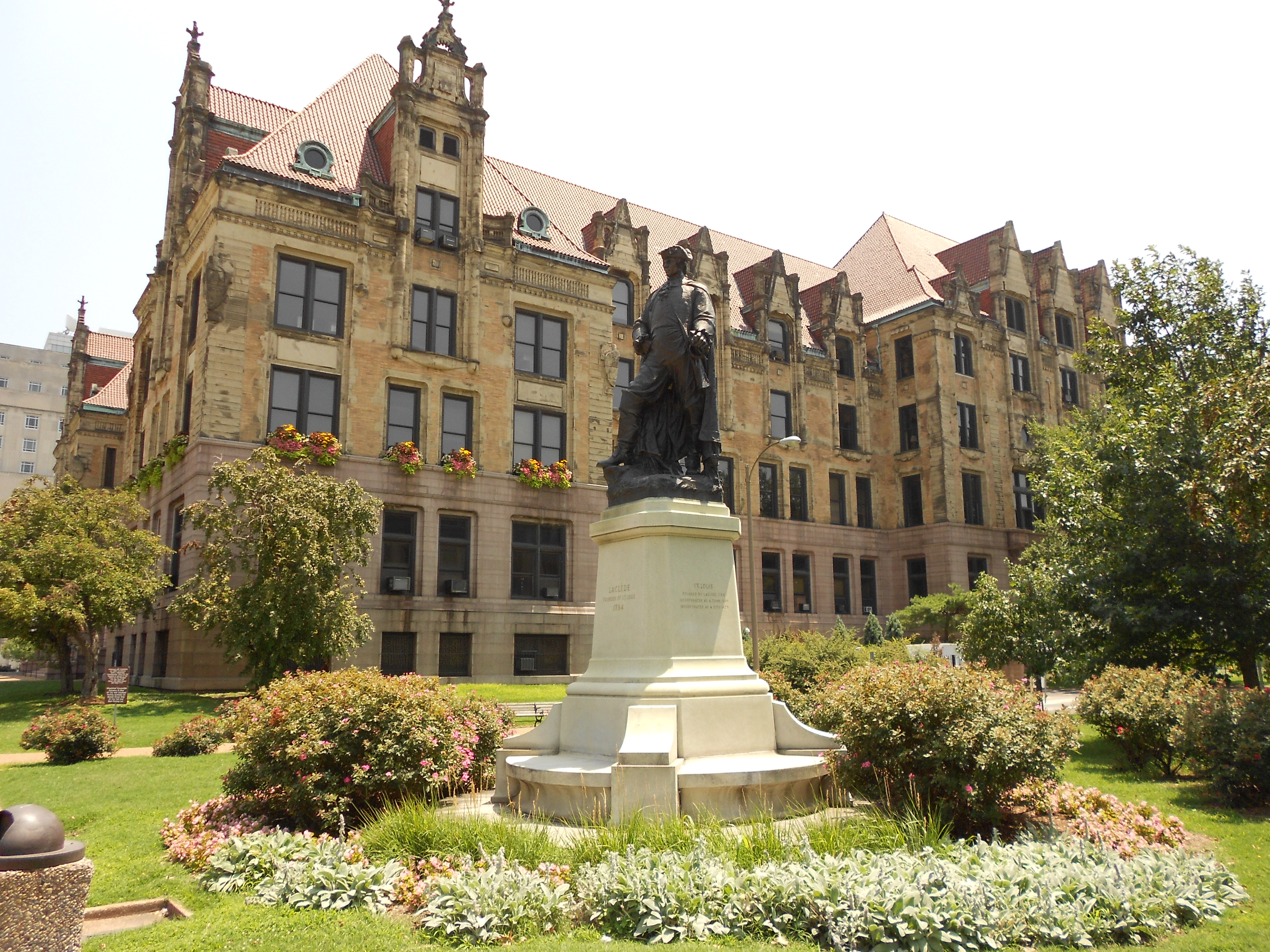
Was Dickmann any different? He claimed he was. Shortly after he had been elected in 1933 he had workers scrub the exterior of the ornate, four-story City Hall. High-pressure hoses had washed the blackened walls of the 1898 building with its distinctive French Renaissance style that resembled the Paris Hotel de Ville. As the soot washed off it exposed the original colors. Longtime residents were shocked to see the first floor Missouri pink granite topped by the Roman pink-orange bricks that graced the upper levels.

Dickmann, the popular bachelor, had been the first Democrat to take control of the city in more than 20 years.   Short, and barrel-chested, Bernard Francis Dickmann liked being mayor. Born to a prosperous St. Louis family, Dickmann was a realtor and president of the St. Louis Real Estate Exchange when the party in 1933 turned to him. He had never run for office, but he had toiled as a loyal Democrat for 20 years and he knew he had benefited from latching on to the coat-tails of Franklin Delano Roosevelt. He also knew his party ties would only help him so far, so from the beginning he had made cleaning up the city’s air one of his highest priorities.

In February 1935 Dickmann had created a blue-ribbon committee to report on how to solve the smoke problem. It was standard practice in St. Louis for politicians to appoint groups to study the city’s smoke and to come up with a solution. But Dickmann’s study committee was different. Within a month he had a report back and the recommendation was drastic – stop burning soft coal from Illinois. That was not going to fly politically but Dickmann and his aides got a watered-down version adopted by the city after a terrible Christmas smoke pall frightened up enough votes in December 1935. Yet even this watered down version proved controversial. While the new ordinance did not prohibit the sale of Illinois coal, it required that the coal be “washed” or cleaned before it could be sold within the city limits. Coal coming into St. Louis often was coated with both fly ash and sulfur, and when burned it produced much of the soot and smoke. The ordinance also established a new Smoke Regulation Department with a commissioner to carry out and enforce its new provisions.

Those requirements were too much for those in Illinois who would have to supply this “washed” coal. Coal operators in nearby Belleville predicted that 50 percent of their industry would be wiped out by the onerous and financially ruinous requirements. The Progressive Miners of America said that “10,000 will starve if the ordinance is passed and St. Louis will lose the trade of the coal producing counties.” A mining company from nearby St. Clair County in Illinois filed a federal court suit, arguing that the ordinance was discriminatory, unreasonable and interfered with interstate commerce.

Dickmann went to Belleville and tried to reassure the city’s critics, explaining that “St. Louis wanted their business but not their dirt.” His comments did not go over well, and some Illinois communities began warning that their citizens would boycott St. Louis goods if the city did not back down.

Did the coal miners and operators truly have that much power?

The newspaper campaign strikes

The story so far: On November 28, 1939, 75 years ago, a thick, black smoke covered St. Louis, turning day into night, snarling traffic and angering and shocking residents. For years the city and every other major urban area had been plagued each winter by these blankets of coal smoke.

By Bob Wyss

JP II had had it. The publisher of the St. Louis Post-Dispatch, Joseph Pulitzer II,

was increasingly vexed because each time his train crossed the Mississippi River and arrived in St. Louis he was greeted by clouds of smoke.

Earlier in the fall of 1939 Pulitzer directed his staff to assemble a team and to begin an old-fashioned crusade against the smoke problem. The reporter chosen was Sam J. Shelton, an Army sergeant during World War I who had already made a name for himself as an investigative reporter. While Shelton’s name would appear on only a few stories (bylines were dispersed sparingly), he was behind most of the coverage. In the newsroom, he was dubbed the smoke editor.

On the editorial side was Ralph Coghlan, the editorial page editor, and cartoonist Daniel R. Fitzpatrick, two longtime journalists unafraid of expressing strong opinions. Coghlan, owlish and ruddy-faced, was known for his acerbic pen and flare for the dramatic. Once, he got so upset when a politician was acquitted in a local court that his editorial of outrage earned him a contempt of court citation and 20 days in jail. After another venture the Governor of Missouri threatened to jail Coghlan. Eventually Pulitzer would banish Coghlan to Europe after one too many drunken brawls.

Daniel Fitzpatrick was never quite as colorful in his 45-year career at the Post Dispatch. He was already a veteran newspaper cartoonist when the Post-Dispatch hired him at the age of 22. Now, after 25 years at the paper and having won one Pulitzer Prize, the sandy-haired, white-mustached Fitzpatrick was one of the top cartoonists in America, according to Time magazine.

The first Post-Dispatch editorial began November 13 by complaining about the city’s air pollution and declaring that “something must be done, or else…” Shelton’s stories were also running and he wrote a long memo outlining the newspaper’s smoke campaign. Coghlan was also eager for another fight. He wrote Pulitzer that the smoke problem was challenging, but “it was not insuperable. It seems to me that here is a classic opportunity for St. Louis to cut the Gordian knot instead of fiddling around and trying to untie it.”

The city’s two rival newspapers quickly responded to the Post-Dispatch campaign. On November 14 the evening St. Louis Star-Times published an editorial declaring that “St. Louis is sick and tired of smoke.” Called the Green Sheet, the Star-Times was small but nimble on such stories. The editorial added: “It is ridiculous to suppose that a modern American city, simply because it is located close to Illinois soft coal fields, must submit indefinitely to smoke blankets.”

When Coghlan saw the editorial he was alarmed. He tore it out, and in a thick black pen wrote a memo to Pulitzer directly on the newsprint. “The Star-Times is getting warm,” he wrote. “It is getting perilously close to our idea.”

St-Louis-Flags

The three city newspapers

On Friday, November 24 the St. Louis Globe-Democrat joined the fray. “What St. Louis demands is remedy,” the Globe-Democrat declared editorially. “The vicious smoke nuisance demands drastic, big-visioned steps. Only when such a movement materializes will the city have any hope of banishing the smoke plague.” Unlike the Star-Times, the Globe-Democrat had the resources to match the Post-Dispatch in news coverage and a great managing editor in Joseph McAuliffe. McAuliffe had earned respect his first day as a cub reporter, covering a murder suicide during the day and a train wreck that night. Plus it had a great editorial page editor in Casper S. Yost.

By now all three newspapers were not only writing about the smoke nuisance but editorially they were calling for the city to take over the privately-run coal business. The Sunday, November 26 Post-Dispatch was especially succinct – the city should buy a “smokeless fuel” from wholesale suppliers and establish depots throughout St. Louis. “St. Louis has been talking about smoke for 50 years,” it said. “Let’s do something about it.” Published adjacent to the editorial was a cartoon depicting numerous chimneys and smokestacks belching smoke, including one prominent stack where the smoke billowed up and arms were grasping a house that was beginning to splinter and fall apart. At the bottom it said: “Can’t Go On Forever.”

The Post-Dispatch reported that it had “been swamped with letters from readers pleading, insisting, even shouting for an attack upon the evil which is ruining our city.” In an unusual gesture, it quoted portions of both the recent Star-Times and Globe-Democrat editorials demanding change.

All of this ferver came in the days before the massive black cloud enveloped the city on November 28. Now that the smoke had arrived, pressure was building. The city could no longer hope that these clouds would dissipate by themselves.

The Morning After – Change is Promised

The story so far:  On November 28, 1939, 75 years ago, a thick, black smoke covered St. Louis, turning day into night, snarling traffic and angering and shocking residents.  Mayor Bernard Dickmann vowed to end the air pollution, but offered no solutions.

By Bob Wyss

It was the morning after. Raymond Tucker was scheduled to talk to the Missouri Federation of Women’s Clubs.  If he had a prepared talk, it was abandoned after what had happened the day before.  Tucker was in charge of the city’s air quality.  He held the title smoke commissioner, although some called him the smoke czar.  After a day in which visibility had fallen to ten feet, he may have held the most unpopular job in St. Louis.

Tucker told the women that despite yesterday’s debacle, change was coming. “In the near future the city administration will give you a program, fixing a date on which smoke can be eliminated,” he said.  “Of course, this cannot happen overnight.  We are seriously studying all the suggestions which have been made to us.  However, I do not intend to recommend something which will be known as Tucker’s Folly.”

He urged the women to do whatever they could to burn cleaner fuel in their homes, and to convince their neighbors to do the same.  The women then approved a resolution calling upon the 10,640 club women in the St. Louis area to cooperate.

It was not like  St. Louis, and much of the industrialized world had not had warnings about the dangers of this smoke problem.  Across the urban centers of North America and Europe bilious clouds of coal smoke would often arise on cold winter days more often than fog and it had been going on for decades.  It was an air pollution than one could see, smell and breathe – and it was dangerous to everything from the economy to human health.

Henry Obermeyer, in a 1933 book Stop That Smoke, railed at the dimensions of what the nation faced.  He said that the corrosive smoke was causing buildings to rot at their foundation, merchandise in stores was spoiling, laundry bills “were beyond reason,” parks and gardens were being stripped of vegetation and electric light costs to illuminate the daylight were rising.stop that smoke

He could cite specific examples.  In Pittsburgh one cost was the mortar in the stones of the city’s buildings.  The mortar was decaying, being eaten by the acidic clouds of winter air pollution.  New York could judge it by the loss of its landscape in Central Park. In 1928 the city spent $873,420 to replace the trees and shrubs that botanists said were dying from the air pollution.  In Washington the marble façade of the Washington Monument was discoloring and showing signs of disintegration. Soot from nearby government buildings was staining the Lincoln Memorial. In Paris, the City of Light, the coal smoke was so thick that it was blackening Notre Dame and the acidic fumes were eating at the cathedral’s ornamental monuments.

“Much of the beautiful carving on one façade of the cathedral has already been badly eaten by the corrosive action of smoke-laden incrustations,” a report at the time warned.

Obermeyer said that smoke was just not harming property, it was killing people.  Every breath of the smoke-laden air meant that people were inhaling six times more in dangerous chemicals than was safe.  A former Chicago city health commissioner had concluded that residents in urban areas were dying from respiratory problems caused by the coal smoke at a rate 60 percent higher than in rural areas.  Children were particularly at risk.

washington monument

The most obvious solution was to stop using the coal that was creating the problem, but that would be like deciding not to use gasoline in automobiles or electricity for lighting. America depended on coal for better than 50 percent of its energy, far more than any other source including oil or natural gas.   King coal was the foundation of the nation’s wealth.  It fired the nation’s iron foundries, steel mills and factories, ran its locomotives and especially warmed the hearths of most homes.  Humans had been using coal beginning 6,000 years.

Nowhere was the air pollution worse than St. Louis.  A 1937 study found that the city’s level of sulfur in the air was twice as high as Pittsburgh and three times dirtier than Detroit’s. A separate study declared that St. Louis had the foulest air in the nation.  Geography and geology were the causes. The confluence of the Mississippi and Missouri Rivers had built the city’s commercial hub but those lower river valleys were also ideal for trapping pollution.  Plus, the coal St. Louis depended on was nearby in rich veins in Southern Illinois and it was cheap, costing as little at $3 to $4 a ton.  But that soft coal was rich in sulfur.  There was better quality coal, bituminous and anthracite, but it cost twice as much and came from as far away as Pennsylvania.

Tucker could say what he wanted to the women of St. Louis.  But it was going to take a miracle to make the air clean again.  And yet even as Tucker spoke, an old adversary was preparing to help the smoke czar.

A Coal Black Sky Descends on St. Louis

Wilma Hornsey was going to be late.  A recent graduate of Miss Hickey’s Secretarial School, she had only been working in the cashier’s office of Union Electric in downtown St. Louis, Missouri for a few months.  She peered down Grand Avenue searching for her bus.  She saw nothing but black.  Even though the sun had been up for some time, the city was shrouded in a thick, black cloud.

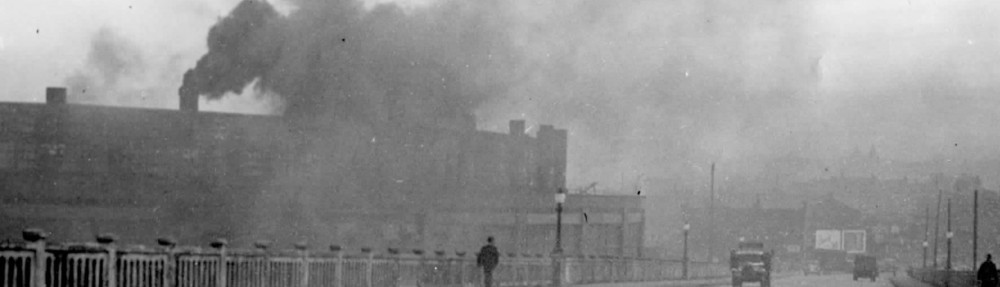
Today, November 28, 1939, virtually everyone would be late. Day turned to night.  Thick black acrid clouds covered the sky.  The thick haze blotted out the winter sun and blackened the city. Street lamps were ignited, storefronts blazed, and transportation slowed or ground to a halt.

Passengers on a trolley car grew increasingly upset as the vehicle slowed on the downtown streets.  One edged up and told the driver “Let me off at Thirteenth and Washington – if you can find it.” Passengers on one bus aided the driver in looking for regular patrons who seemed “lost in the fog at their accustomed street corners.”  Passengers would call out the window the names of the missing, and guide them to the bus.

Motorists driving in from the suburbs said had left in a bright sunny glare.  The sun disappeared when they neared the city. One commuter on Grand Avenue reported visibility was down to 10 feet and he was going 15 miles an hour.  Another driver followed a white center line down a main thoroughfare, State Street, but lost his bearing when he turned onto a side street.  He wound up on the sidewalk, facing the wrong way.

Parking lot attendants downtown tried to guide vehicles to the curb cuts of their respective lots, by using flashlights.  One put flares in discarded oil cans and placed them at the entrance of driveways to help guide in drivers.   At the corner of Grand Boulevard and Olive Street a boy hawking newspapers pretended to have a gas mask by placing a paper sack over his head with holes cut out for his eyes.

It was impossible not to inhale the smoke, even inside buildings.  At City Hospital on this day nurses and interns were wearing gauze masks on their face, although few of the patients had donned them.  The vapor was thick enough, said Joseph Knapp, that “you’d think you were in a coal mine. It was terrible.”  Knapp, who was only 30, was in the hospital being treated for a lung ailment.  “Look at the soot on my bed,” he said.  “I noticed it first about 9 o’clock last night when the smoke first made me cough.  It was difficult to breath.”

Edward Schanz, who was in for a heart ailment, agreed.  “It made me choke and cough,” said the 65 year old.  I had difficulty breathing.”

St. Louis Mayor Bernard Dickmann called his city cabinet together in an emergency meeting.  They agreed that the smoke was terrible; something had to be done, but what.  An aide, Raymond Tucker, reported that phone calls had been coming into City Hall all day.  His office would log 240.  People were angry, even abusive.  St. Louis had experienced air pollution for decades, but never this bad.  Dickman told his staff he was willing to take desperate measures, but he was vague when he talked to reporter late in the day.  He was determined, he told them,  “to rid St. Louis of the smoke menace.” The solution, he added was that “the city should keep its feet on the ground and not undertake any program without careful study.”

By mid-afternoon a slight breeze came up and began to push some of the smoke out of the city, easing traffic going home.

The smoke was the big story in the evening papers, even nearly as big as the news from Europe where the Nazis were again on the attack. The front page of the Post-Dispatch picture was striking, showing the General Grant statue at Twelfth and Market standing eerily in the dark at 9 in the morning.  City Hall, which was directly behind the statue, could not be glimpsed.  “St. Louis Chokes in Smoke, Ninth Big Blackout in Month,” declared the Post-Dispatch  while the St. Louis Star-Times reported “Season’s Worst Smoke Pall Settles on City; Hundreds Late to Business.”

DSCN0630                                     St. Louis City Hall and the Grant Statue
Others were more affected and disgusted.  By the end of the day Wilma Hornsey made it home to the apartment she shared with her brother and sister without any problem.  She had been late to the office that morning, but no one seemed to notice.  Now, she realized her white gloves were already smudged with soot. Often the coal smoke would get under her skirt, turning her white petticoat gray.  Why, she wondered, were young women expected to wear so much white on these dark days?

As darkness came, the temperature fell to below freezing, and across the city people were firing their furnaces.  The wind was also dying and clouds of smoke began billowing again, thickening, lowering visibility, and making people cough.

It had to feel as if God had weighed in and told the city that it was running out of time.